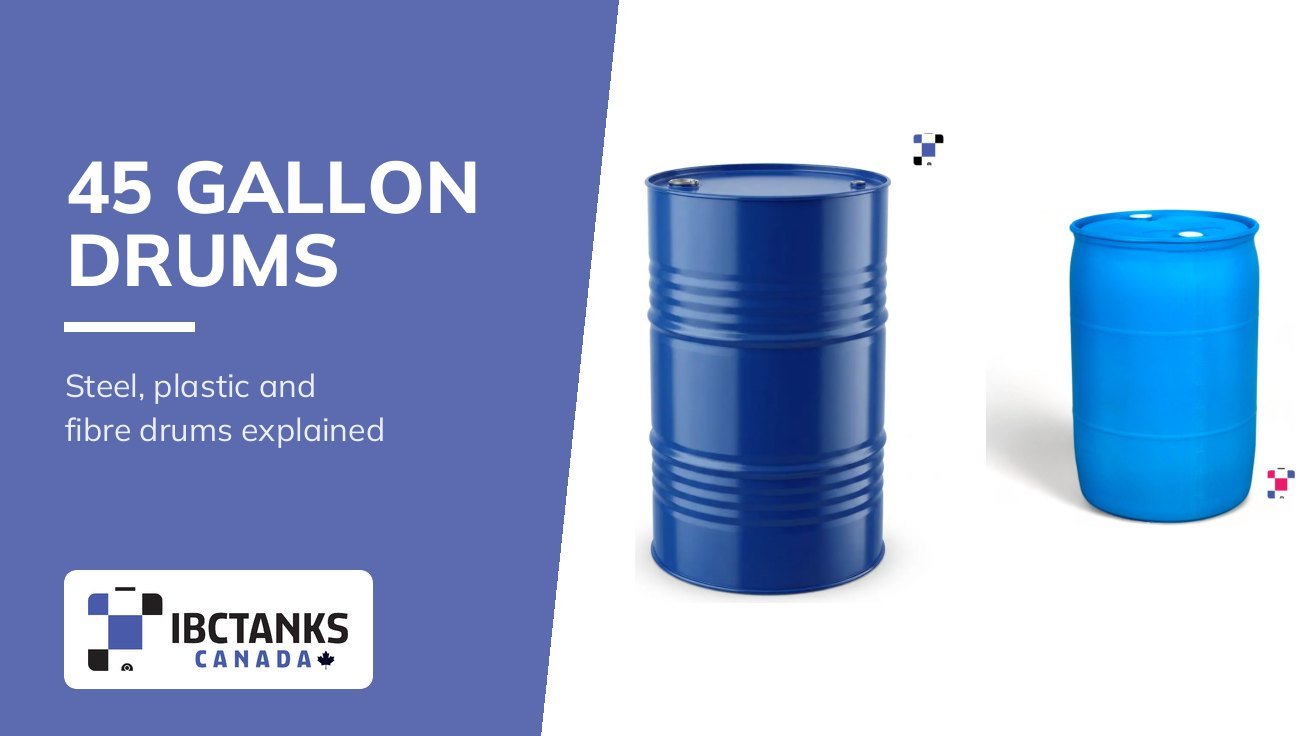

Quick answer: in Canada, a 45 gallon drum is the same drum the US calls a 55 gallon drum. 45 imperial gallons is about 205 L and 55 US gallons is about 208 L, so both names describe the standard 205 L drum, roughly 23 in (584 mm) across and 34.5 to 36.4 in (876 to 924 mm) tall.
| Name | Unit | Litres |
|---|---|---|
| 45 gallon drum | Imperial gallons (Canada, UK) | about 205 L |
| 55 gallon drum | US gallons | about 208 L |
| Labelled capacity | Metric | 200, 205, 208 or 210 L |
Ask for a 45 gallon drum in Calgary or Thunder Bay and you will be handed exactly the same drum a supplier in Ohio calls a 55 gallon drum. The difference is not the drum. It is the gallon. Canada grew up on imperial gallons, the United States uses US gallons, and the industry settled on one standard drum of roughly 205 litres that both names describe.
This guide clears up the naming, then walks through the drum types you will find in Canada, what the UN markings mean and how to choose the right drum for your liquid or dry product.
Need exact measurements? Our 55 gallon barrel dimensions guide and 55 gallon drum diameter guide have the full spec tables.
Why Canadians Call It a 45 Gallon Drum
An imperial gallon is about 4.546 litres. A US gallon is about 3.785 litres. Run the numbers on the standard drum and both names line up:
- 45 imperial gallons x 4.546 L = about 204.6 L
- 55 US gallons x 3.785 L = about 208.2 L
That difference of a few litres is less than the variation between drum makers, so in practice it is the same container. You will see it labelled as 200 L, 205 L, 208 L or 210 L depending on the manufacturer and whether the figure is the nominal or brimful capacity. Our own listings show this range too, from a 200 L closed-head plastic drum to a 210 L tight-head steel drum.
The confusion runs the other way as well. If someone outside Canada asks for 55 imperial gallons, that is about 250 L, which is a different and less common size. When accuracy matters, always ask for the capacity in litres. Our 55 gallons to litres guide covers the conversion in more detail.
Standard 45 Gallon Drum Dimensions
| Specification | Steel drum | Plastic (HDPE) drum |
|---|---|---|
| Capacity | about 205 L (45 imp gal / 55 US gal) | about 205 L (45 imp gal / 55 US gal) |
| Outside diameter | about 23 in (584 mm) | about 23.3 in (592 mm) |
| Height | about 34.5 in (876 mm) | about 36.4 in (924 mm) |
| Empty weight | 40 to 50 lb (18 to 23 kg) | 20 to 25 lb (9 to 11 kg) |
These are typical figures. Exact sizes vary slightly between makers, so check the spec sheet if the drum has to fit a rack, a drum cradle or a spill containment pallet.
The Main Types of 45 Gallon Drums
Drums are sorted by two things: what they are made of, and whether the lid comes off.
Steel Drums
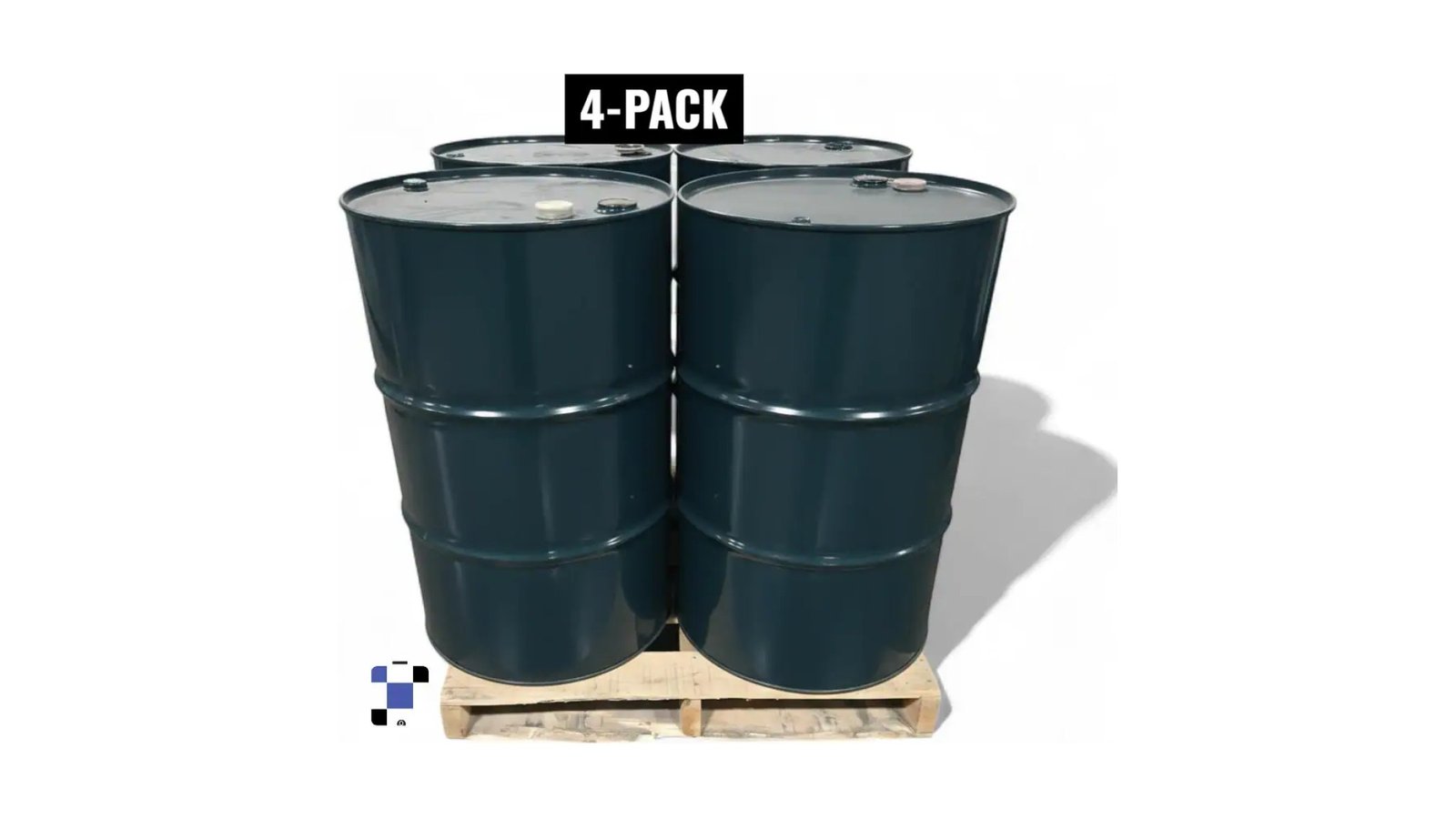
Steel drums are the classic oil drum: strong, puncture resistant and tolerant of higher temperatures. They are used for oils, lubricants, solvents, paints and many industrial chemicals. Inside, they may be bare steel or lined with a coating to protect against corrosion. Our new 210 L UN-rated tight-head steel drum is designed for liquids, with threaded bung openings in the top.
Plastic (HDPE) Drums
Plastic drums are made from high-density polyethylene. They are lighter than steel, will not rust and resist a wide range of acids, alkalis and water-based products. That makes them a popular choice for water storage, food ingredients, detergents and agricultural products. Our brand-new closed-head plastic drum is UN rated, certified food safe and has one 2 in buttress (coarse) bung and one 2 in NPS (fine) bung. HDPE does have a temperature limit: the new HDPE drums in our 8-pack, for example, are rated to 65 °C (150 °F).
Fibre Drums
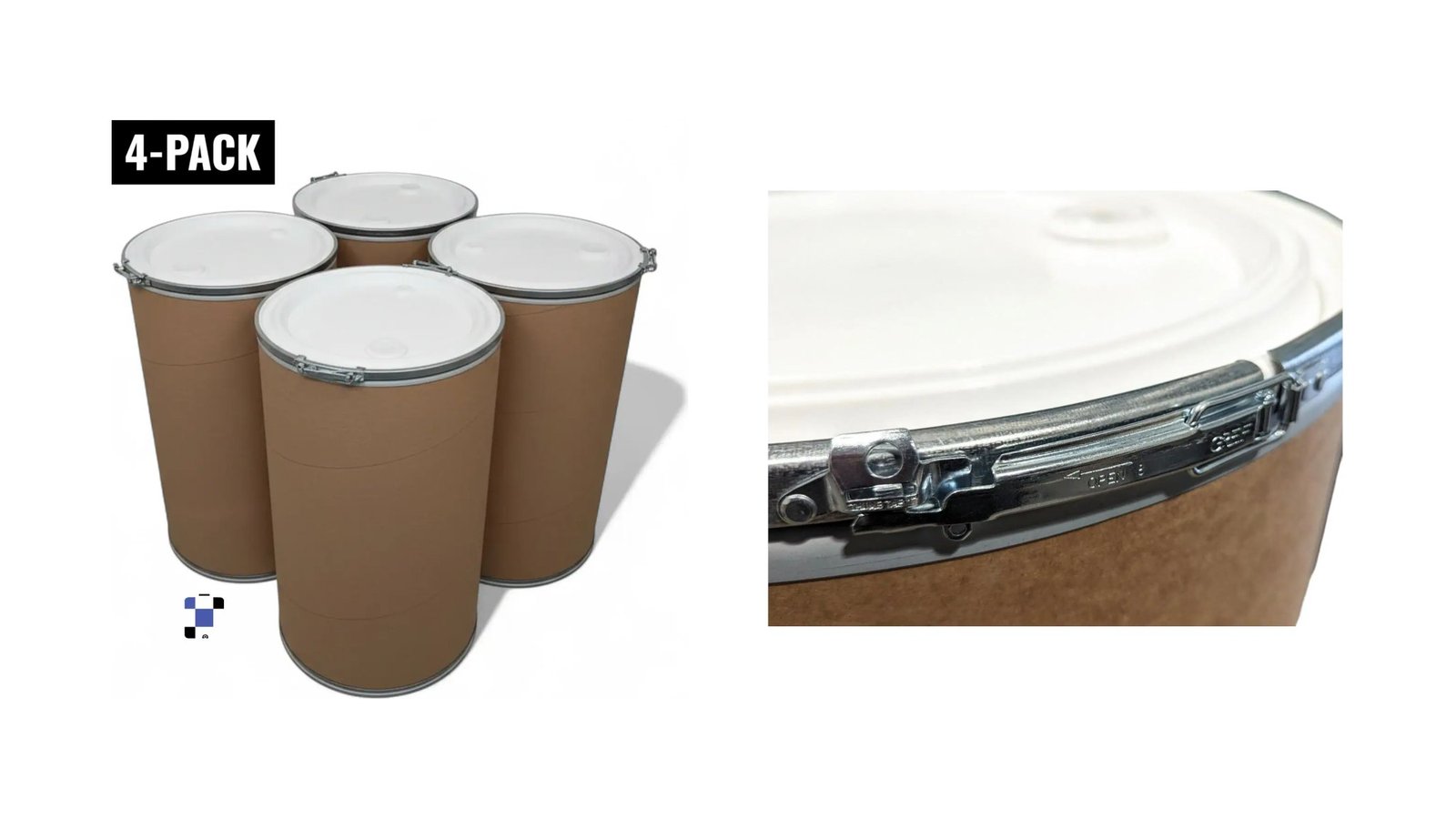
Fibre drums have walls made from layers of heavy paperboard, usually with a steel or plastic lid held on by a lever-lock ring. They are light and economical for dry goods such as powders, granules and food ingredients. They are not made for free liquids. Our open-head fibre drums previously held dry food ingredients and come with a plastic lid and lever-lock steel rim, with liners sold separately.
Tight-Head Versus Open-Head
This is the other big choice, and it applies to both steel and plastic drums:
- Tight-head (closed-head) drums have a fixed top with two small threaded openings called bungs, usually one 2 in and one 3/4 in on steel drums. They are built for liquids, which you fill and empty through the bungs or with a drum pump.
- Open-head drums have a removable lid held on by a bolt ring or lever-lock ring. They are built for solids, sludges, thick products and anything you need to scoop out.
Use a tight-head drum for liquids whenever you can. The fixed top is stronger and seals far better than a lid and gasket.
Reading the UN Marking on a Drum
If you ship or store dangerous goods in drums, the UN marking matters. In Canada, the Transportation of Dangerous Goods (TDG) Regulations require most dangerous goods to travel in containers that meet a recognised standard and carry the right marking. The code moulded or stamped into a drum tells you what it was tested for.
Take the marking on our new plastic drums as an example: UN 1H1/Y1.6/100.
- 1: the container is a drum.
- H: the material is plastic. Steel is A and fibre is G.
- 1: non-removable head (tight-head). A 2 here means a removable head (open-head).
- Y: approved for packing groups II and III. X covers packing groups I, II and III, and Z covers packing group III only.
- 1.6: the maximum specific gravity of liquid the drum was tested with.
- 100: the hydrostatic test pressure in kilopascals.
So a steel tight-head drum is a 1A1, a steel open-head drum is a 1A2, and a plastic open-head drum is a 1H2. Open-head drums for solids are marked with a maximum gross mass in kilograms and an “S” instead of a specific gravity and test pressure.
Important: a UN rating is only valid for the use it was tested for. A reconditioned drum may also need to be re-tested and re-marked before it can carry dangerous goods again. If you are not shipping dangerous goods, a non-UN drum is usually fine and costs less.
New or Reconditioned: Which Should You Buy?
Both have a place. The right choice depends on what the drum will hold.
When to Buy New
- Drinking water, food or anything that will be eaten or drunk
- Dangerous goods that need a current UN rating
- Products that could react with traces of a previous fill
When Reconditioned Makes Sense
- Non-hazardous liquids and general industrial use
- Rain barrels, garden water and general storage projects
- Bulk buyers looking to cut cost per drum
Our reconditioned closed-head plastic drums are cleaned, UN rated for hazardous materials and sold singly or in four-packs, and our reconditioned non-UN steel drums suit non-hazardous liquids. If you plan to store water, read our guide to choosing a drum of water first, because the drum’s previous contents matter a great deal.
Handling and Storing 45 Gallon Drums Safely
A full drum is heavy. Water weighs 1 kg per litre, so a drum holding 205 L of water weighs about 205 kg plus the drum itself, and denser products weigh more. Plan your handling before you fill.
- Move full drums with equipment: use a drum dolly, drum truck or forklift attachment. Never try to walk a full drum across the floor on its rim.
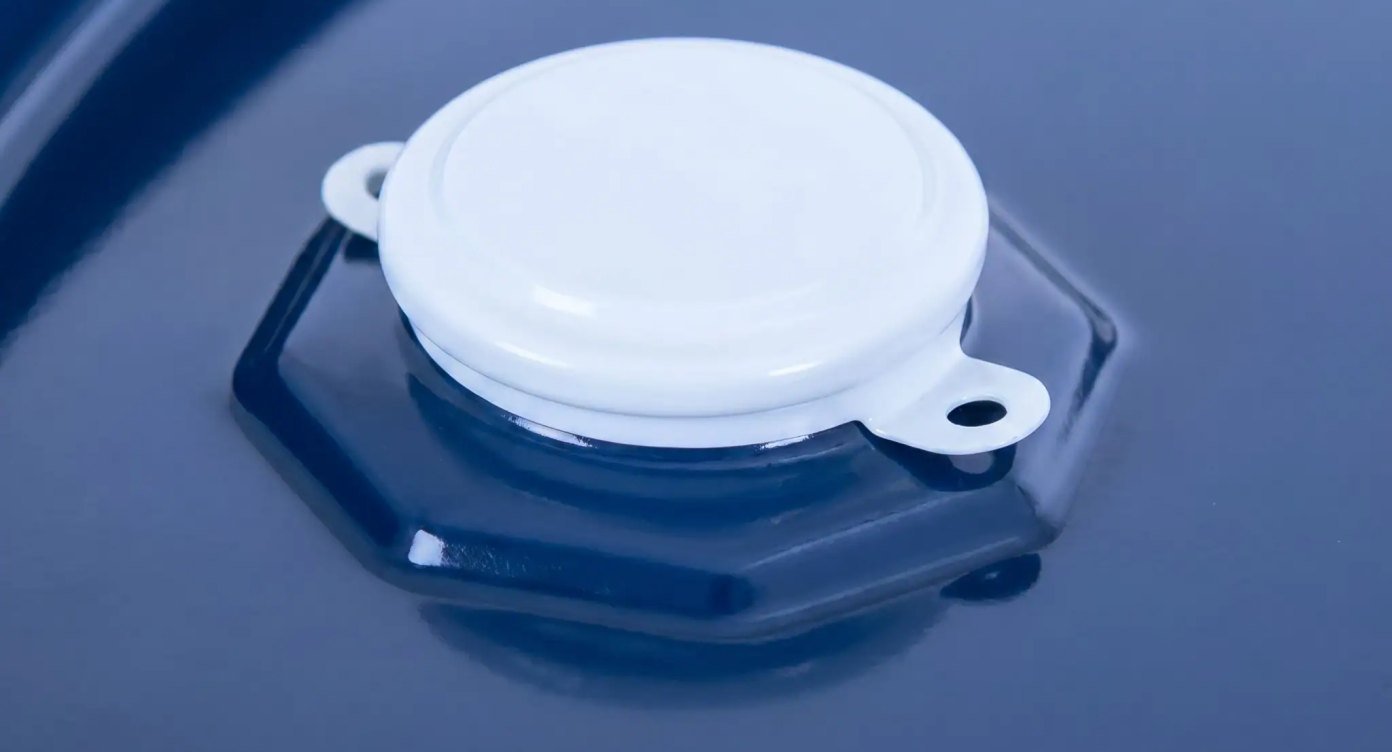
- Open bungs with the right tool: a non-sparking aluminium bung wrench fits 2 in and 3/4 in bungs and is the safe choice around flammable liquids.
- Use containment: store drums of oil and chemicals on a spill pallet sized to hold leaks from the largest drum. A guide to oil drum dimensions helps you plan pallet layouts.
- Keep bungs tight: loose bungs let moisture in and vapours out.
- Protect from freezing: water-based products can freeze and split a drum, just as they can damage a tote. The same winter steps we cover for IBC tote heaters apply to drums.
- Add a valve or tap: a 2 in male NPT ball valve with camlock outlet turns a drum into a simple dispenser. Our guide to camlock fittings explains how to connect a hose to it.
If a drum does leak or tip over, act quickly to contain it. This practical overview of hazardous waste and spill cleanup explains the steps for assessing and containing a chemical spill.
Drum or IBC Tote?
When you need more than four or five drums of the same product, an IBC tote is often the better option. A 1000 L tote holds about as much as five 205 L drums, takes up one pallet footprint and drains through a single valve. Drums still win when you need smaller lots, several different products or containers that one person can move with a dolly. See our guide to bulk container IBC totes for a side-by-side view.
Your Questions About 45 Gallon Drums, Answered
Is a 45 Gallon Drum Smaller Than a 55 Gallon Drum?
No. They are the same drum. “45 gallon” uses imperial gallons and “55 gallon” uses US gallons, and both work out to roughly 205 to 208 litres.
How Many Litres Does a 45 Gallon Drum Hold?
About 205 L. You will see it listed anywhere from 200 L to 210 L depending on the maker and whether the number is nominal or brimful capacity.
Can I Store Drinking Water in a 45 Gallon Drum?
Yes, if the drum is food grade and has only ever held food-grade contents. A brand-new food-safe plastic drum is the safest choice. Never use a drum that has held chemicals, fuel or unknown products for drinking water.
What Size Are the Bung Holes?
Most tight-head drums have one 2 in bung and one 3/4 in bung. On plastic drums both openings are often 2 in, with one coarse (buttress) and one fine (NPS) thread, so check the listing before buying a tap or valve.
Do I Need a UN-Rated Drum?
Only if you are transporting regulated dangerous goods, or your customer or site rules require it. For water, garden use and non-hazardous products, a non-UN drum is usually fine.
At IBC Tanks Canada, we stock new and reconditioned steel, plastic and fibre drums, along with bung wrenches, valves and taps, all shipped from Mississauga with local pickup available. Find the right drum for your job at https://ibctanks.ca.