Camlock Fittings: Types, Sizes and How to Match Them

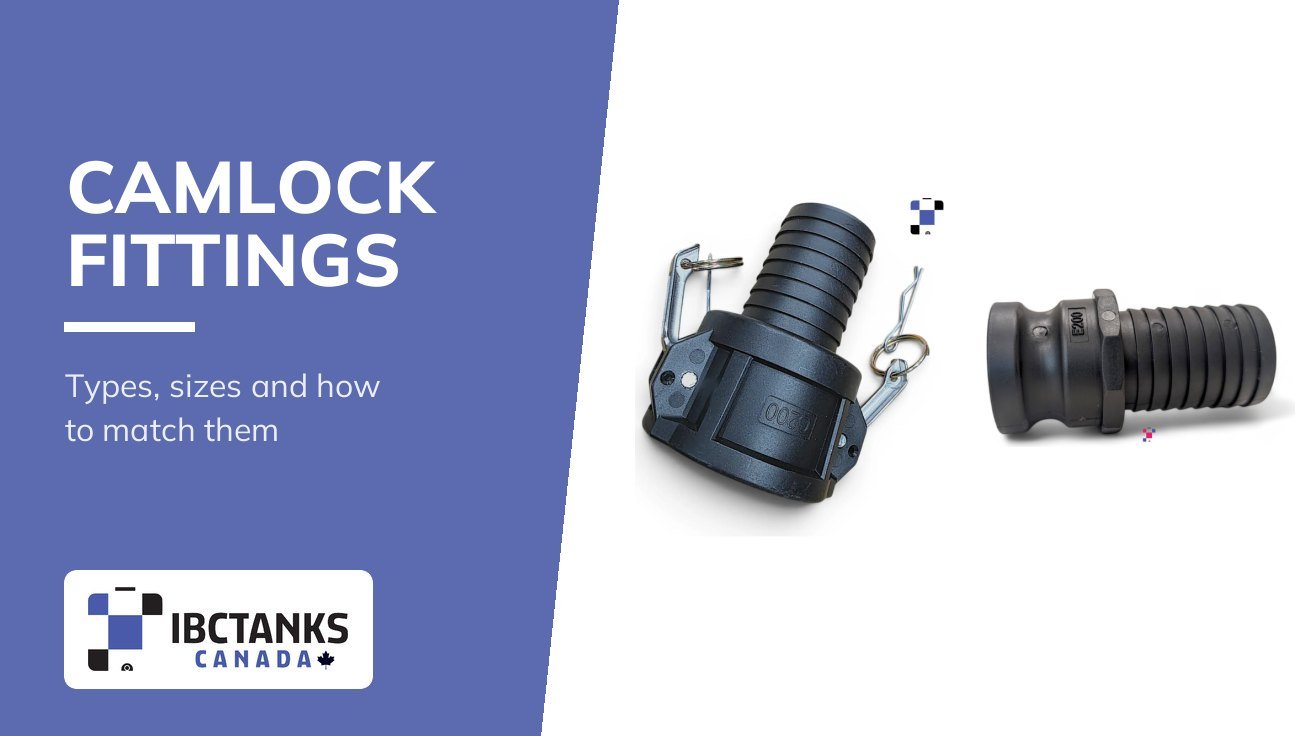
Quick answer: camlock fittings (also called cam and groove couplings) join hoses, pipes and valves in seconds without tools. Every fitting is either a male adapter (types A, E and F) or a female coupler with cam arms (types B, C and D), plus dust caps (DC) and dust plugs (DP). Any male and female of the same size will connect, whatever the brand or material.
| Type | Half | Other end |
|---|---|---|
| A | Male adapter | Female thread |
| B | Female coupler | Male thread |
| C | Female coupler | Hose shank |
| D | Female coupler | Female thread |
| E | Male adapter | Hose shank |
| F | Male adapter | Male thread |
Camlock fittings are the quick-connect couplings you see on IBC tote valves, transfer pumps, tanker trucks and irrigation lines. Push the female coupler over the male adapter, fold the two cam arms down and you have a sealed connection. Lift the arms and it comes apart. No wrenches, no thread tape and no cross-threading.
The system is simple once you know the letter codes. This guide explains the types, sizes, materials and gaskets, and shows how to match camlocks to the valve on your IBC tote.
Need the full picture on tote threads first? Our guide to IBC tote fittings explains buttress and NPT threads and how to identify the outlet on your valve.
How Camlock Fittings Work
A camlock connection has two halves:
- The male adapter is a plain tube with a groove machined or moulded around it.
- The female coupler is a socket with a gasket inside and two hinged cam arms on the sides.
When the male adapter is pushed into the coupler and the arms are closed, cams on the arms press into the groove. That pulls the adapter tight against the gasket and locks it in place. Because the seal depends on the gasket rather than on threads, the connection can be made and broken many times a day without wearing out.
Cam and groove couplings are built to common dimensional standards. In North America the reference is the US federal specification A-A-59326 (which replaced the older military standard MIL-C-27487), and in Europe it is EN 14420-7, which replaced DIN 2828. If you want the technical background, the cam and groove coupling entry gives a good overview. The practical upshot is simple: a 2 inch male adapter from one maker will fit a 2 inch female coupler from another.
The Camlock Types Explained
Every camlock has a letter code that tells you two things: which half of the connection it is, and what is on the other end. The sizes are written after the letter, so a C200 is a type C in 2 inch, and an E50 is a type E in 1/2 inch.
Male Adapters: Types A, E and F
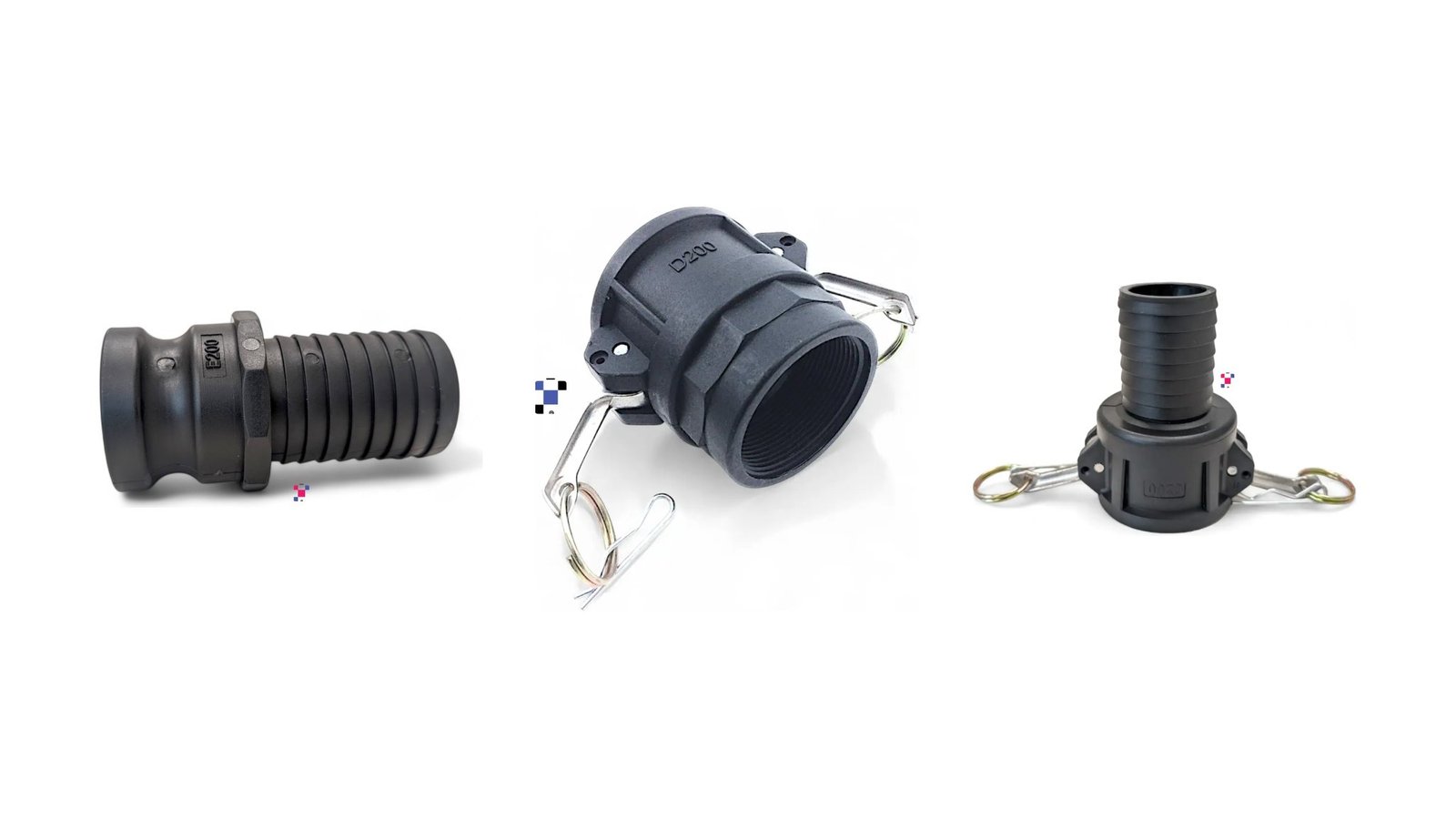
- Type A: male adapter with a female thread on the back. It screws onto a male-threaded pipe or valve outlet.
- Type E: male adapter with a hose shank (barb). Push a hose over the shank and clamp it. Our 2 inch E200 male camlock to hose barb is a common example.
- Type F: male adapter with a male thread on the back. It screws into a female-threaded port.
Female Couplers: Types B, C and D
- Type B: female coupler with a male thread. It threads into a female port, such as a tank fitting.
- Type C: female coupler with a hose shank. This is the usual fitting on the end of a transfer hose. See the 2 inch C200 female camlock to hose barb.
- Type D: female coupler with a female thread. It screws onto a male-threaded pipe or outlet, for example our 2 inch female NPT to D200 female camlock.
Caps and Plugs: DC and DP
- DC (dust cap): a female cap with cam arms that closes off a male adapter.
- DP (dust plug): a male plug that closes off a female coupler.
Caps and plugs matter more than they look. They keep dirt, insects and rain out of an idle connection and stop drips from a valve that is not fully closed.
Easy way to remember: types A, E and F are the male “plug-in” half. Types B, C and D are the female half with the arms. Then ask what is on the back: thread (and which gender) or a hose shank.
Camlock Sizes and How to Measure Them
Camlock size refers to the nominal pipe or hose size, not to the outside diameter of the fitting. Common sizes run from 1/2 inch up to 6 inch, with 2 inch being the size you will meet most often on IBC totes. We stock sizes from 1/2 inch to 4 inch in our adapter range.
A 2 inch camlock will only connect to another 2 inch camlock. If your hose is 1 1/2 inch but your valve outlet is 2 inch, you need a reducing adapter rather than a different camlock.
Common Camlock Codes at a Glance
| Code | Type | Size | Typical use |
|---|---|---|---|
| E50 | Male adapter x hose shank | 1/2 in | Small hose connections |
| C125 / C150 | Female coupler x hose shank | 1 1/4 in / 1 1/2 in | Pump and transfer hoses |
| B200 | Female coupler x male thread | 2 in | Threading into tank and valve ports |
| C200 | Female coupler x hose shank | 2 in | The hose end that clips onto an IBC valve |
| E200 | Male adapter x hose shank | 2 in | Hose end that connects to a female coupler |
| B300 / E400 | Female or male, larger sizes | 3 in / 4 in | High-flow transfer and suction lines |
Matching Camlocks to Your IBC Tote Valve
Most IBC tote valves have a 2 inch outlet. What you attach depends on what that outlet already has on it.
If the Valve Already Has a Male Camlock
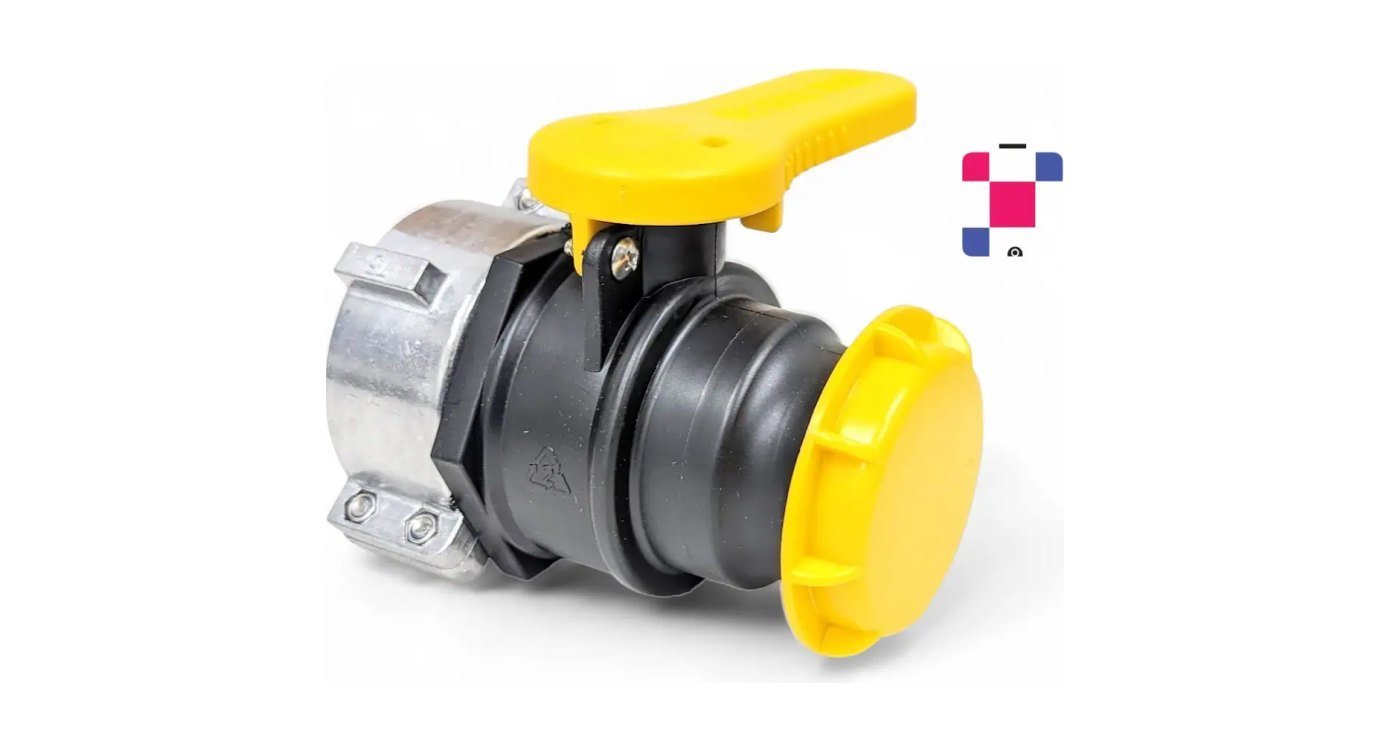
Many totes, including the valves in our IBC tote valve assemblies, come with a 2 inch male camlock outlet and a dust cap. You simply need a 2 inch female coupler on your hose (type C) or on your next fitting (type B or D). To fill watering cans, a 2 inch female camlock brass tap snaps straight on.
If the Valve Has a Buttress or NPT Thread
Many valves have a 2 inch buttress (coarse, often marked S60x6) thread or a 2 inch NPT (fine) thread instead. In that case you need a thread-to-camlock adapter first:
- 2 inch female buttress to 2 inch male camlock for coarse-thread valves.
- 2 inch female NPT fine thread to 2 inch male camlock for fine-thread valves.
- Original CPP adapters in food-grade polypropylene, with a short male camlock and a gasket, for a low-profile connection.
Not sure which thread you have? Thread an adapter on by hand. Buttress threads feel chunky and square, and NPT threads are finer and tapered. If it binds after a turn or two, stop and check rather than forcing it.
Valve Collar Size Is a Separate Question
Do not confuse the outlet with the collar. The collar is where the valve attaches to the bottle, and it is usually 62 mm or 75 mm depending on the bottle maker. That only matters if you are replacing the whole valve. The camlock and thread on the outlet side are what your hose connects to.
Choosing the Right Material and Gasket
Camlocks are made in several materials. The right one depends on what flows through it, the pressure and how rough the handling will be.
Body Materials
- Polypropylene: light, inexpensive and resistant to many chemicals. This is the material used for most IBC tote adapters, and our CPP fittings use food-grade polypropylene.
- Aluminium: strong and light, widely used for fuel, water and general transfer work.
- Stainless steel: the choice for food, beverage and aggressive chemicals where you need corrosion resistance and easy cleaning.
- Brass: durable and common for water and fuel service.
- Nylon: light and economical for low-pressure water and agricultural use.
Gasket Materials
The gasket does the sealing, so it has to suit the liquid as well:
- Buna-N (nitrile): the standard gasket for water and petroleum products.
- EPDM: good for water and many water-based chemicals, but not for petroleum oils or fuels.
- Viton (FKM): for fuels, oils and a wide range of chemicals where Buna-N or EPDM will swell or break down.
- PTFE: for highly aggressive chemicals.
Our replacement IBC valves come with EPDM or Viton gaskets, so you can match the gasket to the product. If you are moving fuel, this guide to fuel transfer systems explains why hoses and lines in fuel service must resist fuel.
Using Camlocks Safely
Camlocks are easy to use, which is exactly why people get careless with them. A few habits prevent most spills:
- Never disconnect under pressure: close the valve, stop the pump and let the line drain before you open the arms.
- Close both arms fully: a half-closed arm can pop open when the line pressurises. Locking arm versions and safety pins are available for critical lines.
- Check the gasket: a cracked, flattened or missing gasket is the most common cause of leaks.
- Respect the pressure rating: ratings vary by size and material. Polypropylene fittings are rated lower than metal ones, so check the rating for your fitting.
- Use containment: when transferring chemicals, keep the connection over a drip tray or a spill containment pallet.
In cold weather, drain hoses and fittings after use. Water left in a camlock connection can freeze and split the coupler or damage the gasket, the same way it damages tote valves. We cover winter protection for the tote itself in our guide to IBC tote heaters.
Got Questions About Camlock Fittings? We’ve Got Answers
Are Camlock and Cam and Groove the Same Thing?
Yes. “Camlock” started as a brand name and is now used for the whole category of cam and groove couplings. Quick connect is another common name.
Can I Mix Camlocks From Different Brands or Materials?
In most cases, yes. Fittings made to the same standard and size are interchangeable, so a polypropylene male adapter will fit an aluminium female coupler. Check that the pressure rating and the gasket suit the job, because the connection is only as strong as its weakest part.
Which Camlock Do I Need for a Garden Hose?
For a 2 inch male camlock on an IBC valve, use a 2 inch female camlock to 3/4 inch garden hose adapter. It snaps onto the valve and gives you a standard hose connection, which is ideal for rainwater and garden totes.
Why Is My Camlock Leaking?
The usual causes are a worn or missing gasket, arms that are not fully closed, a damaged groove on the male adapter or mismatched sizes. Replace the gasket first, since it is the cheapest fix and the most common culprit.
Are Polypropylene Camlocks Food Safe?
Some are. Food-grade polypropylene fittings, such as our CPP adapters, are made for food contact. Standard polypropylene fittings may not be, so check the product details before using a fitting with food, drinks or drinking water.
At IBC Tanks Canada, we stock camlock fittings, thread adapters, valves, taps and hose kits for IBC totes and drums, all shipped from Mississauga with local pickup available. Find the right connection for your tote at https://ibctanks.ca.