


Think of a spill containment skid as a purpose-built safety net for your big chemical containers, like Intermediate Bulk Containers (IBCs). It’s a seriously tough, heavy-duty platform with a built-in basin designed to catch 100% of any leaks, drips, or spills. This simple piece of gear is absolutely essential for stopping hazardous stuff from contaminating your facility and the environment, keeping you safe and compliant.
What Spill Containment Skids Actually Do
Picture this: you have an IBC tote holding hundreds of litres of a corrosive chemical. A tiny, unnoticed leak from a bad valve or a hairline crack in the container wall could quickly escalate into a massive headache. Without any protection, that liquid would spread all over the floor, creating a nasty slip hazard, releasing toxic fumes, and possibly finding its way into drains or the soil.
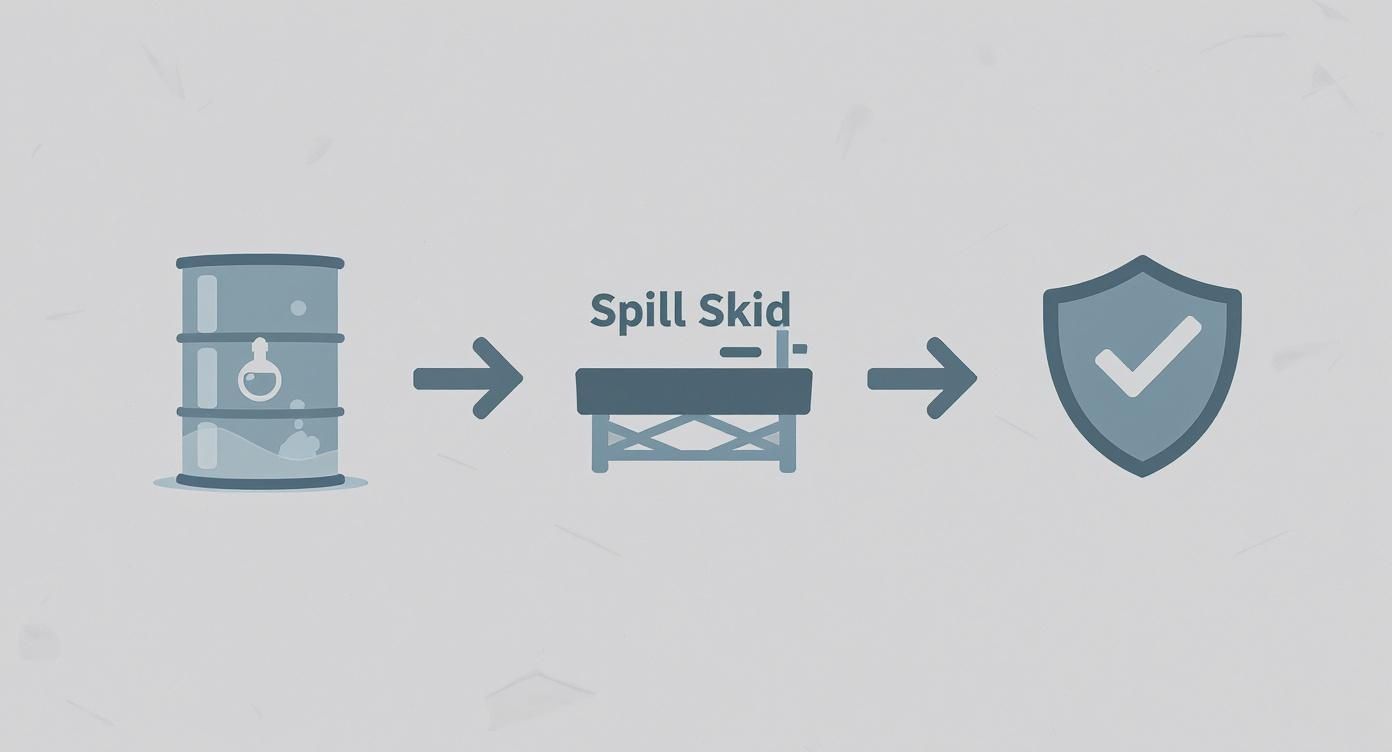
A spill containment skid is your first line of defence. When you place the IBC tote right on top of it, you’ve essentially created a self-contained unit. The platform holds the full weight of the tote, while the built-in sump—the basin underneath—is always on standby to catch anything that escapes.
Why This is a Big Deal for Your Operations
This straightforward concept has a huge impact on any business handling bulk liquids. At their core, spill containment skids are all about managing risk. They’re designed to protect three crucial parts of your operation:
- Your People: Keeping your team safe from slips, falls, and exposure to dangerous chemicals is always priority number one. A spill that’s contained is a situation you can control; one that isn't is an immediate safety crisis.
- Your Property: Chemical spills can eat through concrete floors, destroy expensive equipment, and force you into costly, time-consuming cleanups that bring productivity to a grinding halt. A skid keeps the mess small and manageable.
- Your Compliance: In Canada, federal and provincial regulations require secondary containment for hazardous materials. Using the right skid is how you meet those legal obligations and dodge hefty fines.
It’s Not Just a Plastic Tray
It’s easy to look at a spill containment skid and see nothing more than a big piece of plastic or steel, but the design is far more deliberate than that. Think of it less like a simple tray and more like a piece of engineered safety equipment.
A spill containment skid isn't just a precaution; it's a proactive strategy. It turns a potential environmental and financial disaster into a manageable cleanup task, protecting your assets and keeping you on the right side of the law.
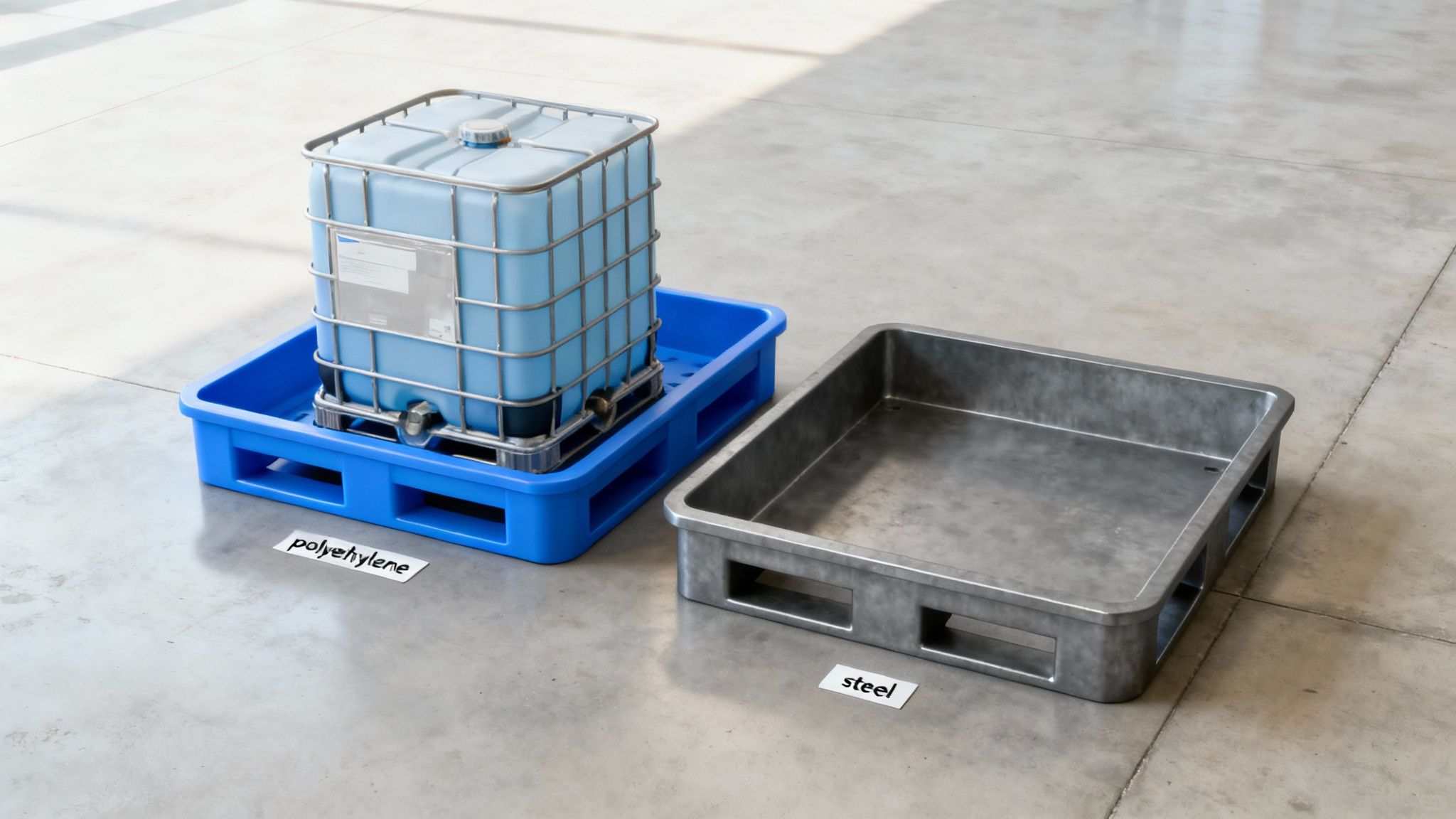
These skids are made from materials specifically chosen for their chemical resistance and strength. For example, polyethylene models are perfect for acids because they won't rust or corrode. On the other hand, steel skids offer incredible strength for extra-heavy loads and non-reactive chemicals.
Many also come with smart features that make your workflow safer and easier, like forklift pockets for moving them around and grates that keep the container up and out of any spilled liquid. This is key, as it stops the tote from sitting in its own mess, which could cause the container to break down even faster. For industries like manufacturing, agriculture, and chemical processing where IBCs are the workhorses, these skids aren't just an accessory—they're a fundamental part of running a safe, compliant, and efficient operation.
Meeting Canadian Secondary Containment Regulations
Navigating safety rules can feel like wandering through a labyrinth. Yet, when you handle bulk liquids in Canada, the requirement for secondary containment is crystal clear—federal and provincial regulations leave no wiggle room.
Think of your storage setup as a two-layer defence. The IBC tote up top is your “primary” container. Below it, the spill containment skid provides the “secondary” barrier. If the tote springs a leak—say from a faulty valve—the skid captures 100% of its contents, stopping that drip from turning into a disaster.
Falling short of these rules carries real consequences: heavy fines, forced shutdowns and damaged reputations. In short, this isn’t a box you can afford to leave unchecked.
Understanding The Critical 110% Rule
The backbone of spill containment in Canada goes by the “110% rule.” It sounds simple—and it is.
Your secondary containment must hold at least 110% of the volume of the largest single container placed on it.
That extra 10% serves as a safety buffer. It compensates for the surge of liquid in a sudden rupture and even captures light rainfall if you’re storing tanks outdoors. No guesswork—just a clear standard that keeps your site and the environment protected.
How To Calculate Your Required Capacity
Getting your numbers right takes just two steps:
Step 1: Identify the Largest Container’s Volume
Find out the maximum capacity of the biggest IBC tote on your skid. In Canada, a standard tote usually holds 1,040 litres.
Step 2: Apply the 110% Factor
Multiply that volume by 1.10 to determine the minimum sump size.
Example For A Single IBC Tote
- Largest Container Volume: 1,040 litres
- Calculation: 1,040 L × 1.10 = 1,144 litres
Your spill containment skid needs a sump capacity of at least 1,144 litres to stay compliant.
This straightforward formula ensures you always pick the right skid for your operations.
Sizing For Multiple IBC Totes
When your skid holds two, four or more totes, the 110% rule still hinges on the single largest container—not the combined volume.
Example For A Two-Tote Skid
- Volume Of The Largest Single Container: 1,040 litres
- Required Capacity: 1,040 L × 1.10 = 1,144 litres
Even with multiple tanks, your sump must meet that 1,144 litre benchmark. That consistency makes compliance easy, no matter how many totes you run.
For a deeper dive into this topic, check out our comprehensive guides on secondary containment: Secondary Containment
Choosing the Right Skid Material and Construction
Picking the right size for your spill containment skid is a great start, but it's only half the battle. The material the skid is made from is just as crucial. Get it wrong, and you're setting yourself up for a potential disaster.
Think about it like trying to carry water in a paper bag—it’s just the wrong tool for the job. The same logic applies here. The skid’s material absolutely must be chemically compatible with the liquids you’re storing. If it isn't, the material could degrade, crack, or even melt, leading to a complete and catastrophic containment failure.
For the most part, you'll be choosing between two main options: polyethylene (a tough, durable plastic) and steel. Each has its own strengths and is built for different jobs. Getting to know their pros and cons is the key to making a smart, safe, and cost-effective decision.
Polyethylene: The Versatile Workhorse
There’s a good reason why high-density polyethylene (HDPE) is the most popular material for spill skids. Its biggest advantage is its incredible chemical resistance.
Polyethylene simply doesn't react to a massive range of chemicals, including the kinds of aggressive acids, caustics, and corrosives that would chew through metal in no time. This makes it a go-to, reliable choice for facilities that handle a lot of different chemical products. For instance, if you're storing sulphuric acid or sodium hydroxide, a polyethylene skid isn't just a good choice—it's the only safe one.
On top of that, polyethylene will never rust or corrode. You can use it outdoors or in damp environments without a second thought. This natural durability means a longer service life with very little upkeep, giving you excellent value over the long haul.
Steel: The Heavy-Duty Champion
While polyethylene is the king of chemical resistance, steel is the undisputed champion when it comes to brute strength and fire safety. Steel spill containment skids are engineered to handle extreme loads, making them the perfect fit for storing exceptionally heavy IBC totes or dense materials.
Their real standout feature is how they perform with flammable liquids and in high-temperature environments. Steel is non-combustible, which is a non-negotiable safety requirement when you’re storing things like solvents, fuels, or other flammable chemicals. In many cases, regulations will flat-out demand non-combustible containment for these substances.
The trade-off, however, is steel's vulnerability to rust and corrosion. Most steel skids come with a tough protective coating, but even a small scratch can expose the raw metal. Once that happens, degradation can set in quickly, especially if it’s exposed to corrosive chemicals or wet conditions.
Choosing a material isn't just a preference; it's a critical part of your risk assessment. The cost of a skid is nothing compared to the cost of a containment failure caused by chemical incompatibility. Always, always check your chemical's Safety Data Sheet (SDS) before you decide on a skid material.
Material Comparison: Polyethylene vs. Steel Skids
To make your decision a little easier, here’s a side-by-side look at the two main materials. This table breaks down their key features, helping you match a material’s strengths to your specific chemicals and workplace needs.
| Feature | Polyethylene Skids | Steel Skids |
|---|---|---|
| Chemical Resistance | Excellent for acids, bases, and corrosives. | Good for non-corrosive chemicals and solvents. |
| Durability | Will not rust or corrode. Impact-resistant. | Extremely strong and puncture-resistant. |
| Weight Capacity | High, but lower than steel. | Highest available for extreme loads. |
| Fire Resistance | Combustible. Not for flammable liquids. | Non-combustible. Required for flammable liquids. |
| Best For | Corrosive chemicals, outdoor use, general-purpose. | Flammable liquids, high-temp areas, heavy loads. |
| Maintenance | Low maintenance, easy to clean. | Requires monitoring for rust and paint damage. |
In the end, the right choice always comes down to the specific liquids you handle. For a wide variety of compatible options, you can explore different types of spill containment pallets designed for various industrial applications. This helps ensure your final choice is not only compliant but perfectly suited to your workplace.
How to Select the Correct Skid Size and Model
Choosing the right spill containment skid isn't just about ticking a box for regulatory compliance. While meeting the minimum capacity rules is non-negotiable, the best skid for your operation will also seamlessly integrate into your daily workflow. The goal is to find a solution that’s not only safe and legal but also practical for your team.
This means you need to look beyond just the sump volume. Think about the big picture: How many IBCs do you need to store? What's their total weight when full? Do they need to be moved around the facility? Answering these questions will help you find the perfect fit, not just a compliant one.
Matching Skid Size to Your IBC Fleet
First things first, you need to figure out the right configuration for your storage needs. Are you dealing with a single tote or managing an entire fleet?
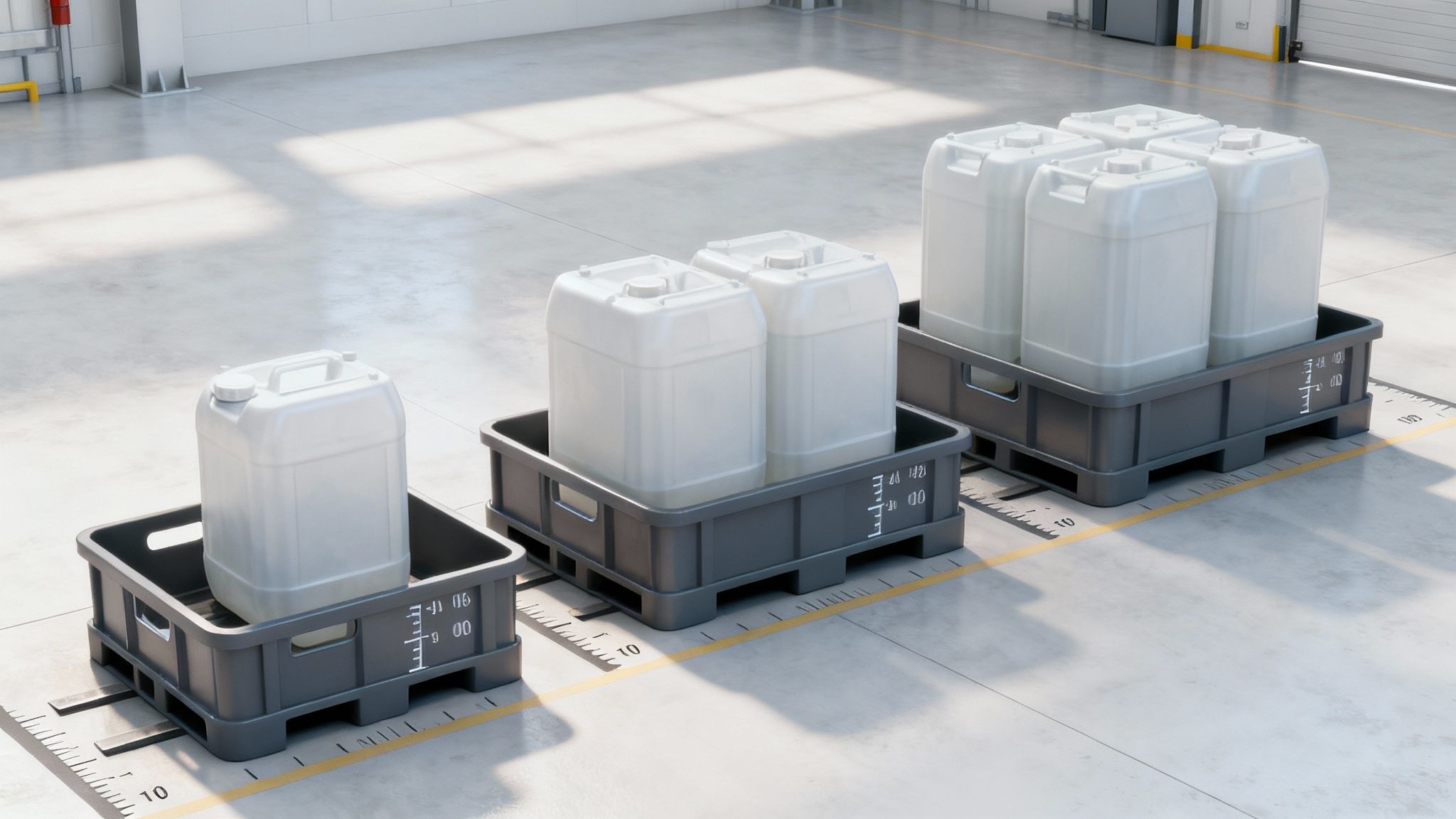
For a single IBC, the choice is pretty straightforward. You'll need a 1-tote spill skid that meets that crucial 110% capacity rule based on your tote’s volume. But as your operation grows, you'll likely need a setup that can handle more.
- 2-Tote and 4-Tote Skids: These larger units are fantastic for saving valuable floor space by consolidating your storage. They let you group multiple IBCs in one secure containment area, which is ideal for organizing different chemicals or setting up a central dispensing station.
Just remember, even with multi-tote skids, the 110% rule still applies to the largest single container you're storing on it—not the total volume of all the totes combined.
Why Load Capacity Is Just as Important as Spill Capacity
It's a common oversight to focus only on spill capacity (how much liquid the sump can hold). But the load capacity—the total weight the skid can safely support—is every bit as important. Neglecting it can lead to structural failure.
Think of it like this: spill capacity protects you from a leak, but load capacity protects you from a complete collapse.
An overloaded skid can crack, buckle, or fail entirely, turning your secondary containment system into the source of a major spill. Always verify that the skid’s static load rating exceeds the combined weight of your IBC totes and their contents.
For perspective, a standard 1,040-litre IBC tote filled with water weighs over 1,000 kg. If you're storing something denser, like certain chemicals or syrups, that weight shoots up even higher. Always calculate the full weight of your loaded totes before you choose a skid. To get your numbers right, it helps to understand the standard dimensions and volumes of IBC totes.
Key Features That Enhance Safety and Efficiency
Beyond size and capacity, certain design features can make a world of difference in how safe and easy your skids are to use. Keep an eye out for models with practical advantages that fit your specific workflow.
Built-In Forklift Pockets
This feature is a game-changer for operational flexibility. Skids with integrated forklift pockets mean you can safely move a loaded IBC without ever having to take it off its containment base. This is a huge help when you need to rearrange your storage area or transport totes to different workstations. For maximum manoeuvrability, look for pockets with four-way entry.
Dispensing Wells
Some skids come with a small, recessed area at the front called a dispensing well. It’s designed to hold a pail or bucket directly under the IBC’s valve, catching any drips and splashes that happen during dispensing. This simple feature helps keep the main deck of the skid clean and prevents dangerous slips.
Modular and Low-Profile Designs
Modular skids can be connected to create a larger, custom-sized containment platform. This is perfect for businesses that are growing—you can expand your storage as needed without having to replace all your existing equipment. Low-profile models, on the other hand, sit closer to the ground, making it much easier (and safer) to load and unload totes.
Ultimately, picking the right model is about finding that sweet spot between regulatory compliance, structural integrity, and day-to-day practicality.
Best Practices For Skid Installation And Maintenance
A spill containment skid only performs as well as its foundation. Start by choosing a level, stable surface—any tilt or unevenness can shift your load and compromise safety.
Before you set anything down, give the area a quick once-over. Look for cracks, rust spots or debris. A tidy base means your skid will function exactly as intended.
Installation Checklist
- Select a level surface away from vehicle traffic.
- Confirm the sump area shows no signs of corrosion or wear.
- Use shims or adjustable pads to correct minor floor irregularities.
- Verify the ground can handle the static load of a fully loaded IBC and skid.
Once the site passes inspection, slide the skid into position within your containment zone. Then, gently lower the IBC tote onto the deck, making sure it sits squarely.
If adjustments are needed, leverage the forklift pockets and built-in grips. Simple, safe handling cuts down on workplace incidents.
“Safety is not an accident”
– Environmental Health and Safety Expert
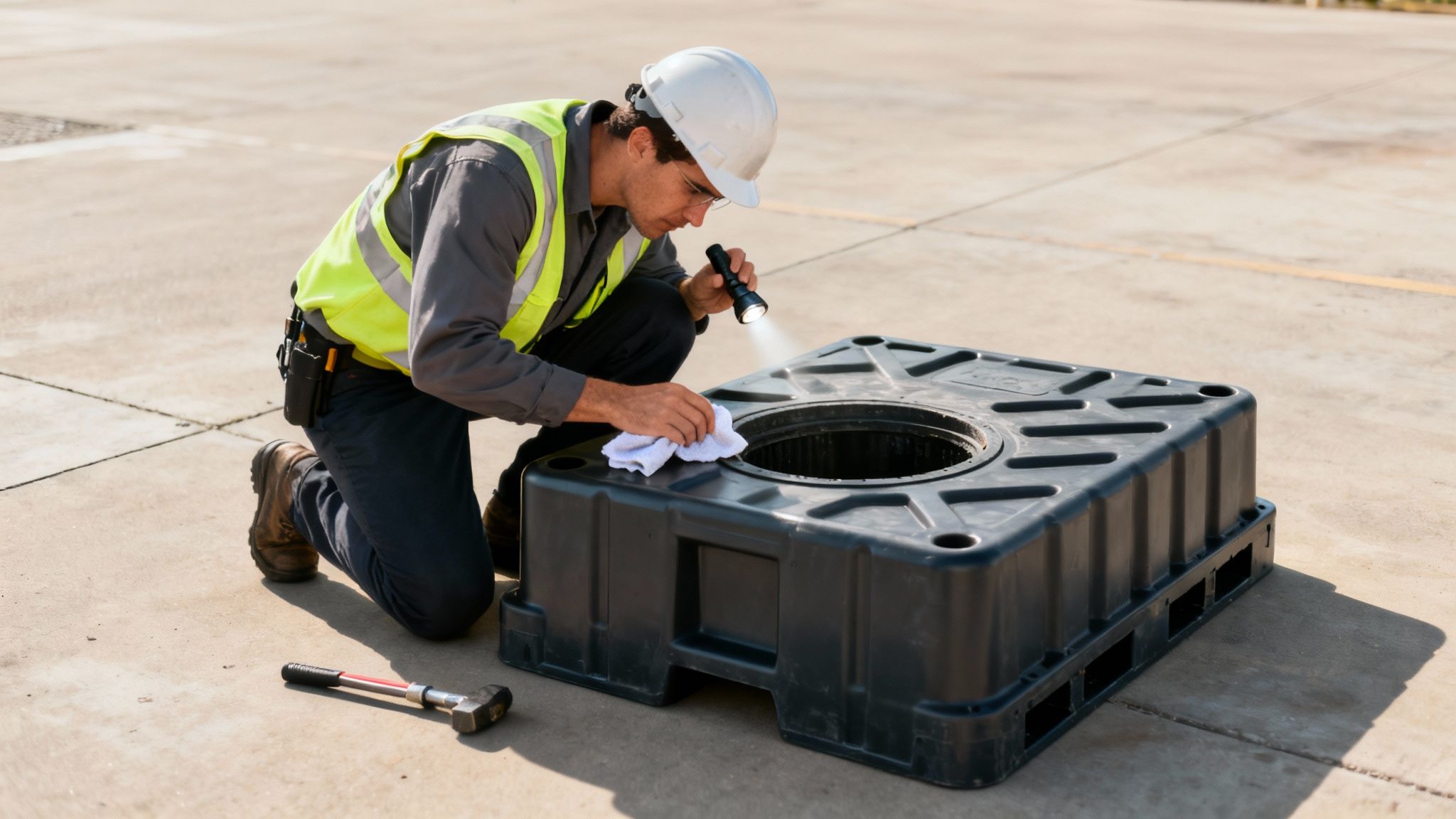
Routine Inspection Steps
Think of weekly inspections as your built-in safety net. Catching small issues early keeps them from becoming big headaches.
- Visually scan for cracks, corrosion or deck warping.
- Clear out rainwater, dust and leaves from the sump. Even a thin layer can cut capacity by 5%.
- Check valve connections for tight seals.
- Look for uneven wear on grates or decking.
- Ensure no chemicals have escaped the containment zone.
Preventative Maintenance Tips
A little cleanup goes a long way. Wipe up drips as soon as they happen to stop residue from building up.
- For polyethylene skids, wash with mild detergent and water—avoid harsh solvents.
- On steel skids, apply a corrosion-resistant coating and touch up paint monthly.
- Replace any cracked grates or worn seals right away. One weak link can let liquids breach the deck.
Adapting To Extreme Scenarios
California’s Camp Fire in 2018 lasted 18 days, claimed 85 lives and levelled 18,804 structures. That disaster taught us that, even with solid equipment, nature can catch us off guard. Learn more about disaster resilience from Paradise Redux: Five Years After Camp Fire.
To stay prepared:
- Install weather-proof covers if skids live outdoors.
- Monitor for ice around valves during cold snaps—frozen buildup can crack bases and trap liquids.
“Proactive maintenance is the best defence against unexpected failures.”
Long-Term Performance Strategies
Treat your skids like any other critical asset. A bit of planning extends their lifespan and keeps you compliant.
Schedule a full service every six months—that means a deep clean, materials check and load test. Document each visit with photos and notes; these records shine during audits and insurance reviews.
Rotate skids in high-traffic areas to even out wear, and update your team on any new procedures. Consistent training builds accountability and confidence.
Key Takeaway
Regular installation checks and thorough maintenance pay dividends by preventing serious incidents.
- Keep a detailed maintenance log and set reminder alerts.
- Consider remote sensors for real-time sump level and leak monitoring.
- Coordinate with your environmental team to align protocols facility-wide.
- Review and refresh staff training once a year.
Got Questions? We’ve Got Answers on Spill Containment Skids
Once you start using spill containment skids, you'll quickly run into real-world questions. These are the tools that bridge the gap between regulations on paper and the day-to-day reality of handling bulk liquids. Getting clear, practical answers helps you make smarter choices, sidestep common headaches, and make sure your team uses this critical gear the right way.
This section tackles the most common questions we hear from facility managers, safety officers, and folks in procurement. We'll give you straight-up answers for everything from chemical compatibility to dealing with Canadian weather, ensuring your spill containment plan is both compliant and genuinely works.
Can I Store Different Chemicals on the Same Skid?
This is a huge safety question, and the answer is a hard no—unless the chemicals are compatible. Putting incompatible chemicals on the same spill skid is asking for trouble. Think about it: if you have a strong acid next to a strong base and both containers spring a leak, they’re going to mix in the sump below.
That kind of mix could set off a violent chemical reaction, releasing toxic fumes, generating intense heat, or even starting a fire. The skid would do its job containing the spill, but you’d have turned it into a dangerous chemical reactor.
To avoid this, you absolutely have to check the Safety Data Sheet (SDS) for every single chemical you're handling. The SDS will tell you exactly what substances it shouldn't mix with.
As a simple rule of thumb, it’s always safest to give incompatible chemicals their own separate spill containment skids. If you’re tight on space, look for skids with built-in dividers that create separate sump compartments. This physically stops leaked materials from ever mixing.
What Do I Do If Rainwater Fills the Sump?
For any skids kept outside, rainwater is a constant battle. When water fills the sump, it eats up your available spill capacity. A sump that's half-full of rainwater means your containment is only at 50% of its required volume, which immediately puts you out of compliance with the 110% rule.
The first thing to do is figure out if that water is contaminated. Even tiny, slow drips from an IBC valve can mix with the rainwater.
- Test the Water: Before you drain a single drop, you have to test the water for chemical contamination. Simple pH strips or more specific test kits can tell you if any hazardous material has found its way in.
- Dispose of It Properly: If the water is clean, you can usually drain it according to your local municipal rules. But if it's contaminated, that water is now legally considered hazardous waste. It has to be pumped out and handled by a licensed waste management company, following all environmental regulations to the letter.
Honestly, prevention is the best approach here. A heavy-duty, weather-resistant tarp or a purpose-built hardtop cover for your outdoor skids will keep rain, snow, and leaves out of the sump in the first place.
Are Skids Required For Non-Hazardous Liquids?
Yes, secondary containment is often required even for liquids not officially labelled as "hazardous waste" under WHMIS. Things like motor oil, hydraulic fluids, coolants, and even certain food-grade oils are still seen as environmental pollutants. Canadian regulations are there to stop any substance that could harm soil or waterways from getting out into the environment.
A big spill of something like used motor oil can contaminate a huge area, leading to very expensive clean-up bills and potential fines from environmental agencies. The word "hazardous" can be a bit misleading; what really matters is the potential for environmental damage.
So, using a spill containment skid for any large volume of industrial liquid isn’t just a best practice—in many places, it’s a legal requirement to prevent pollution.
How Do I Safely Move a Loaded Spill Skid?
Moving a skid with a full, one-tonne IBC on top demands focus and care to avoid tipping or dropping the whole thing. The good news is that most spill containment skids are designed with built-in forklift pockets for this exact reason. Never, ever try to lift a skid from its top edges or sides.
Follow these steps to do it safely:
- Centre the Load: Before lifting, make sure the IBC tote is sitting squarely in the middle of the skid’s deck. An off-centre load is an unstable load.
- Use the Pockets Correctly: Slide the forklift tines all the way into the pockets. Spread the tines as wide as the pockets will let you to create the most stable lifting base possible.
- Lift and Move Slowly: Lift the skid just high enough to clear the floor. Travel at a slow, deliberate speed, especially when turning corners. Avoid any sudden starts, stops, or jerky movements. Keeping the load low to the ground maintains a lower centre of gravity, which is your best friend for stability.
If a spill skid doesn't have forklift pockets, it’s a safe bet it was never designed to be moved with a load on it. In that case, you must empty the IBC or lift it off the skid before you can move the skid itself. It’s a critical difference that can prevent a catastrophic failure and a massive spill.
At IBC Tanks Canada, we provide the robust spill containment skids and accessories you need to keep your operations safe, efficient, and fully compliant. Explore our complete collection of containment solutions and find the perfect fit for your facility's needs at https://ibctanks.ca.